TOP-RATED
Atlanta Criminal Defense
Law Firm
Atlanta Criminal Defense
Law Firm




DWI stands for driving while intoxicated. Some states call it driving while impaired. DUI stands for driving under the influence. States pick one term for the same impaired-driving offense. Georgia charges DUI. DWI is not a Georgia charge name. Whichever label a state uses, the arrest creates a lasting file. Our guide explains whether DWI records are public in Georgia.

The difference between DUI and DWI starts with the words themselves. DWI usually means driving while intoxicated. Some states call it driving while impaired. DUI means driving under the influence. Both describe the same conduct. That conduct is driving after alcohol or drugs affected the driver.
Other states use other letters for the same idea. Maine, Massachusetts, and Rhode Island call it operating under the influence, or OUI. Michigan, Indiana, and Wisconsin use OWI, which means operating while intoxicated. Wyoming uses DWUI. Oregon uses DUII. Ohio uses OVI.
Readers who look up the DWI meaning usually hold paperwork from another state. So what is DWI? The term is that state's name for drunk driving. The letters reflect how that legislature wrote its code. They do not signal a lesser or greater crime.
In a few states, both terms appear in the statutes. Those states use them for different offenses or different levels of impairment. A DWI in one state may not match a DUI in another. Anyone comparing DUI vs DWI should read the elements of the offense, not the letters.
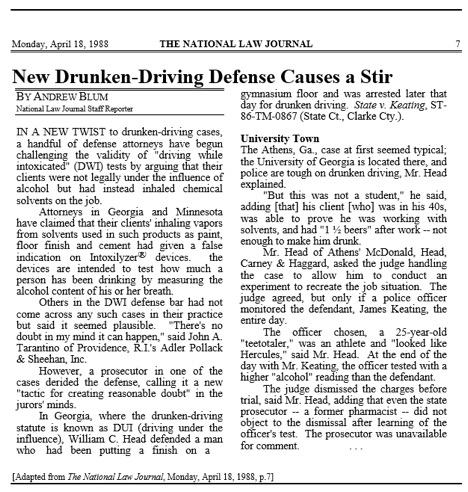
Larry Kohn co-authored The Georgia DUI Trial Practice Manual. That book tracks the offense the same way. Atlanta DUI attorney William C. Head walks through the same DWI vs DUI question in his drinking and driving facts overview.
The state's drunk driving offense is driving under the influence. No separate Georgia charge called DWI exists. A local officer's citation will say DUI. So will a prosecutor's accusation and a grand jury indictment.
Clients often arrive at consultation confused. An employer or relative said DWI. But the citation reads DUI. DWI also turns up in local news coverage and insurance paperwork. Those uses are loose. They point to the same category of offense.
The state's statute describes impaired driving in several ways. A driver may be charged for driving under the influence of alcohol to the extent it is less safe to drive. A charge can rest on blood alcohol level at or above the legal limit. The statute reaches drugs, including prescription drugs. It also reaches any mix of substances.
For drivers twenty-one and over, the per se limit is point zero eight percent. Drivers under twenty-one and truck drivers face lower limits. Georgia DUI charges may be misdemeanors or felonies. The facts determine the level.
Drunk driving law did not start with numbers. Early statutes set no threshold blood alcohol level. Officers testified about the odor of alcohol and a driver's admissions. Breath alcohol testing devices came into use only in the late nineteen thirties. Before that, only blood testing could measure alcohol.
Federal policy then pulled the states together. In nineteen seventy, Congress created the National Highway Traffic Safety Administration to guide states on model highway safety laws. Federal highway funds gave that push its leverage.
States raised the drinking age to twenty-one. They banned any open container of alcohol inside a passenger vehicle. They also adopted implied consent laws. Those laws suspend a license after a refusal or a failed test.
Those model laws also brought fines, jail terms, probation, and community service hours into drunk driving sentencing. They pushed states to make DUI punishable as a felony when a crash causes serious injury or death.
That shared blueprint is why the offense looks similar across state lines. The letters change from state to state. The core rules do not change.
Local drivers get cited for drunk driving while traveling. Other drivers move here with a prior already on the record. We see both patterns often. Both raise the same question: does the different label help?
In many cases, it does not help. Motor vehicle agencies commonly report these convictions to one another. Georgia may treat a prior out-of-state conviction as a prior offense. This applies to licensing and sentencing. The other state called it DWI, but the court here still counts it.
How a prior counts depends on the elements of the other state's offense. The way the conviction was entered also matters. So does the age of the conviction. Drivers should have a lawyer review the certified disposition. That review should come before any guess about how a local court will treat it.
The facts drive the seriousness of a case here, not the acronym. Those facts include the driver's blood alcohol level or other proof of impairment. They include whether this is a first or repeat offense. A child in the car matters. So does a crash or an injury. License status counts as well.
The cost of a first DUI in Georgia often runs into the thousands of dollars.
The proof usually includes the officer's notes. Field sobriety testing and the state-administered breath test add to it. The standard roadside tests are horizontal gaze nystagmus, walk and turn, and one leg stand. A driver may decline those roadside tests. Those tests are voluntary.
Declining field sobriety tests differs from refusing the state-administered breath or blood test. That test falls under the state's implied consent law. A refusal can carry its own license penalty. Those run on a separate schedule from the criminal case.

The difference between driving under the influence and driving while intoxicated is mostly a matter of wording. Readers ask it both ways. The difference between driving while intoxicated and driving under the influence is the same question, just reversed. Put as driving while intoxicated vs driving under the influence, the answer still turns on each state's own statute. In most states, DUI and DWI point to the same offense. Both involve driving a vehicle while impaired by alcohol or drugs. The acronyms and legal limits vary by state. The core conduct each state targets is the same.
More than thirty states use DUI as their official charge name. About ten states use DWI instead. A handful use their own labels – OUI, OWI, OVI, or DWAI. Each state must prove two things. First, the driver operated a vehicle. Second, the driver was impaired or above the legal alcohol limit.
Here is how the main terms compare:
The practical takeaway is simple. A state may call it driving while intoxicated or driving under the influence. The state must still prove impairment or an illegal blood alcohol level. The label on the citation does not make the charge more or less serious. The facts of the stop, test results, and the driver's record determine the outcome.
Some states treat "driving while impaired" as a separate idea from DUI. The driving while impaired vs DUI question matters most in states that split drunk driving into tiers.
New York is one example. New York uses DWAI – driving while ability impaired – for drivers whose blood alcohol falls between point zero five and point zero seven percent. That is a traffic infraction, not a misdemeanor. A driver at point zero eight percent or above faces the more serious DWI charge.
North Carolina also uses "driving while impaired" as its primary offense name. In that state, DWI covers both alcohol and drug impairment under a single label. The word "impaired" in these statutes generally means the driver's ability to drive safely was reduced. Some states set a lower proof bar for impairment charges than for intoxication charges. That split can affect penalties and criminal records.
Georgia uses only the DUI charge name. Every drunk driving case here falls under state law as DUI. The state does split two paths of prosecution:
Both theories carry the same charge name and the same penalties. A driver does not face a lesser impairment charge here. The state uses a single charge name, unlike New York's DWAI tiers.
Every state bars drunk driving. The acronym each state uses depends on how its legislature wrote the statute. Here is a breakdown by label.
DUI (Driving Under the Influence): Georgia, Alabama, Alaska, Arizona, California, Colorado, Connecticut, Delaware, Florida, Hawaii, Idaho, Illinois, Kansas, Kentucky, Louisiana, Maryland, Mississippi, Montana, Nebraska, Nevada, New Hampshire, North Dakota, Oklahoma, Oregon, Pennsylvania, South Carolina, South Dakota, Tennessee, Utah, Vermont, Virginia, Washington, and West Virginia all use DUI or a close variant. These statutes cover both alcohol and drug impairment.
DWI (Driving While Intoxicated): Texas, Missouri, New Jersey, New Mexico, and Arkansas use DWI. North Carolina uses DWI but defines it as "driving while impaired" rather than "intoxicated." Some of these states split alcohol impairment from drug impairment under separate sections.
OUI (Operating Under the Influence): Massachusetts, Maine, and Rhode Island use OUI. The word "operating" broadens the offense beyond driving in motion. A person sitting in a parked car with the engine running may face an OUI charge.
OWI (Operating While Intoxicated): Michigan, Indiana, Wisconsin, and Iowa use OWI. Like OUI, the "operating" wording can reach conduct beyond driving on a public road.
DWAI (Driving While Ability Impaired): New York uses DWAI for lower-level impairment offenses. These typically occur at a blood alcohol level between point zero five and point zero seven. Colorado also uses DWAI as a lesser offense below its DUI threshold.
OVI (Operating a Vehicle Impaired): Ohio replaced its older DUI label with OVI. The statute covers alcohol, drugs, and certain controlled substances.
A simple takeaway applies to all drivers. If you hold a Georgia license and pick up a drunk driving charge in another state, the label on the citation does not decide how the court here treats it. The elements of the offense and how the conviction was entered matter more than the letters.
Federal pressure and model codes pushed every state toward a common framework. All fifty states now set the per se blood alcohol limit at point zero eight for adult drivers. All enforce implied consent rules that punish test refusals. All impose rising penalties for repeat offenses.
Within that shared framework, states keep their own wording and add their own twists. Some prosecute inhalant impairment. Some list specific drugs that trigger per se violations. Some create tiered offenses. A lower charge covers mild impairment while a higher charge covers intoxication above the legal limit.
Georgia uses only the DUI acronym. The state's drunk driving statute covers alcohol, drugs, toxic vapors, and any mix of these substances. The state's code has no separate DWI charge.
The statute does create two paths to prosecution. A driver may be charged with DUI – Less Safe if alcohol made it less safe for that person to drive. A driver may face DUI – Per Se if the alcohol level reached point zero eight grams or more. This must occur within three hours after driving. Prosecutors may charge both theories in the same case.
This two-theory structure is the state's answer to what other states split between separate charges. A state that uses DWI for high blood alcohol levels uses a different name for borderline impairment cases. Georgia draws roughly the same line. The line here sits between Per Se and Less Safe. The difference is that one statute and one charge name cover both. The penalties, license results, and criminal record all flow from state DUI law no matter which theory the state pursues.
Georgia uses only the term DUI. The state has no charge called DWI. All drunk driving cases here are prosecuted under state law as DUI. The statute covers alcohol, drugs, toxic vapors, and mixes of substances. When people here say DWI, they usually mean the same DUI offense.
Neither term is worse by itself. States use both labels for the same category of offense. Severity depends on the facts and on that state's law. The alcohol level, prior offenses, and any injuries all count. The acronym itself changes nothing.
No. State law does not include a DWI offense. The only drunk driving charge is DUI. A citation, accusation, or indictment here says DUI. If you see DWI on insurance paperwork or in conversation, it is a loose reference to the same DUI offense.
DUI stands for driving under the influence. The statute covers driving under the influence of alcohol, drugs, or a mix of substances. The statute also covers driving with blood alcohol level at or above the legal limit.
DWAI stands for driving while ability impaired. New York and Colorado use DWAI as a lesser offense for drivers whose impairment falls below the DUI or DWI threshold. In New York, DWAI typically applies when the blood alcohol level is between point zero five and point zero seven. Georgia has no DWAI charge. Every drunk driving case here is charged as DUI.
Georgia may count a prior out-of-state drunk driving conviction as a prior offense for licensing and sentencing. Much depends on the elements of that state's offense. How the conviction was entered also matters. Drivers should have a lawyer review the certified disposition.
For drivers twenty-one and over, a blood alcohol level of point zero eight percent or higher supports a per se DUI charge. Lower limits apply to drivers under twenty-one and to truck drivers. A driver may also face charges below that limit. The proof must show impairment.
Penalties vary by state, not by acronym. A DUI in one state and a DWI in another may carry similar fines, jail time, and license suspensions. They may also differ a lot. In Georgia, a first DUI conviction carries a fine of not less than three hundred dollars and not more than one thousand dollars. Possible jail time and license suspension also apply. The label on the charge does not change the penalty structure. The facts of the case and the driver's prior record determine the sentence.
Many readers look up the terminology to make sense of a citation. If you were charged here, your case is a DUI. Some drivers face a drunk driving charge from another state. Others carry a prior that followed them here. In both cases, the label matters less than how the courts here treat it.
Whichever acronym the arresting state uses, a conviction can affect your license, insurance rates, and criminal record. These cases carry tight deadlines. The license suspension process requires a timely hearing request. That hearing preserves driving privileges after an arrest.
Kohn & Yager LLC focuses on Georgia DUI defense. The firm handles cases involving alcohol, drugs, and mixed substance charges. We serve metro Atlanta and the rest of the state. Speak with DUI lawyer Larry Kohn, Atlanta DUI attorney Cory Yager, or criminal defense lawyer William C. Head in a free consultation.
A free consultation is available around the clock. Call (404) 567-5515 to speak with a Georgia DUI defense attorney about your case. Do not wait for a court date when license deadlines may already be running. Contact us if you were arrested in Georgia for a DUI charge.