TOP-RATED
Atlanta Criminal Defense
Law Firm
Atlanta Criminal Defense
Law Firm





Drivers who search for how to get out of a DWI in Georgia are asking what most new clients ask us: how do you beat a DUI charge? The honest answer is that it turns on the facts of your arrest. Whether you face a DUI first offense or a repeat charge, every case turns on its own details. A Georgia DUI lawyer must read the arrest paperwork, the test results, and the video before naming a defense that can work. The sections below walk through the defense strategies that apply in Georgia.
How can you beat a DUI charge in Georgia? Usually by attacking one of four things: the stop, the arrest, the testing, or the notice. Georgia law has no separate DWI charge, so how to fight a DWI and how to fight a DUI are the same question here. Many people search for how I beat my DUI case, hoping for a template. There is none, because no two arrests are alike. Learning how to win a DWI case starts with the proof in your own file.
Challenging the legality of the stop. The Fourth Amendment requires an officer to have reasonable articulable suspicion before pulling you over. That means a traffic violation or a crime. Dashcam or bodycam video can show whether the stop was valid. If no valid basis exists, a court may suppress all evidence that followed.
Challenging probable cause for arrest. Officers build probable cause on what they see and hear. That means the odor of alcohol, slurred speech, and bloodshot eyes. They also use field sobriety tests under NHTSA standards. Problems with how a test is given can make it less reliable. The horizontal gaze nystagmus test, walk-and-turn test, and one-leg stand test all have strict rules. Steps skipped in those rules weaken the state's case.
Attacking breath or blood test admissibility. Under Georgia law, chemical test results must meet specific procedural requirements to be admissible. The test must be performed on an approved machine in good working order. The person administering the test must hold a valid permit from the Division of Forensic Sciences. Failures in calibration, operator certification, or approved testing methods create grounds for exclusion.
Attacking implied consent notice compliance. Under Georgia law, implied consent notice rules require officers to read a set notice when the chemical test is requested. Errors in the notice, or a failure to read it, can get the test results thrown out. A license suspension can be reversed too.
Each of these pathways may apply alone or together. The strength of any defense depends on the facts of your arrest.
Picking the right lawyer is one of the biggest decisions you will make after a drunk driving arrest. Look for counsel who works on DUI defense day in and day out, not as one of many practice areas.
One key factor is how well the lawyer knows the court and county where your case will be heard. Prosecutors and judges handle DUI cases in their own way across Georgia's 159 counties. A lawyer who appears in your local court every week knows how motions and plea talks tend to go there.
Ask whether the attorney has training in NHTSA standardized field sobriety testing protocols. Also ask about experience litigating Intoxilyzer 9000 challenges. These are technical areas that require specialized knowledge. An attorney who understands the science behind breath testing can identify weaknesses that a general practitioner may miss. Source-code litigation and calibration records are key areas of focus.
Finally, look for a lawyer willing to file and argue pretrial motions instead of taking the first plea. Many drunk driving cases are won or lost at the motion stage. Evidence can be thrown out before trial ever begins.
A DUI conviction under Georgia law gets worse with each prior conviction inside a ten-year lookback period. Knowing the stakes makes clear why fighting the charge matters.
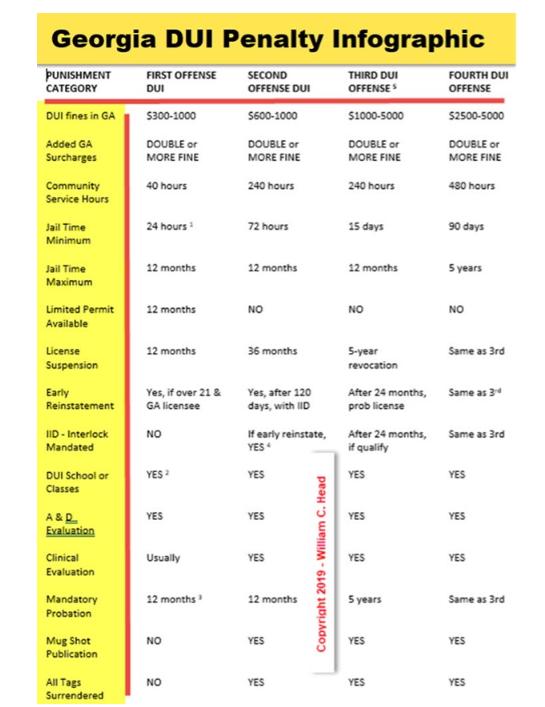
First offense (misdemeanor): A fine of $300 to $1,000 applies. You face up to 12 months in jail. The judge must leave at least 24 hours in place if your BAC was 0.08 grams or more. You must complete at least 40 hours of community service. For an under-21 offense with a BAC below 0.08 grams, the floor is 20 hours. You must finish the DUI Alcohol or Drug Use Risk Reduction Program within 120 days. You must get a clinical evaluation unless the court waives it. You must serve 12 months of probation, minus any time already served.
Second offense (misdemeanor): A fine of $600 to $1,000 applies. The sentence runs 90 days to 12 months. At least 72 hours of that is actual jail, and no judge can probate it. You must complete at least 30 days of community service. You must finish the Risk Reduction Program and get a clinical evaluation. You must serve 12 months of probation.
Third offense (high and aggravated misdemeanor): The mandatory jail time goes up, and so does the community service floor. License penalties reach further as well. A third conviction within ten years marks the driver as a repeat DUI offender with significant long-term consequences.
Fourth or subsequent offense (felony): A fine of $1,000 to $5,000 applies. You face one to five years in prison. A judge may probate all but 90 days of that sentence. You must complete at least 60 days of community service. You must finish the Risk Reduction Program and get a clinical evaluation. You must serve five years of probation, minus time already served.
Beyond these criminal penalties, every conviction triggers a driver's license suspension. An ignition interlock may follow. A permanent criminal record does too. Those added effects reach jobs, insurance rates, and professional licenses for years.

As a driver in Georgia, you have "impliedly" consented to one or more chemical tests. That consent kicks in once you are arrested for driving impaired. This post-arrest testing is governed by the Georgia implied consent law.
If alcohol is not what is impairing you, the test will be a blood test. That test looks for any impairing substance. Refusal puts your right to drive at risk. That is a civil penalty under the Georgia Code.
Police can also seek a search warrant from a judge to draw your blood. They also keep the right to ask for a one-year suspension when you refuse testing. Georgia does not make refusal of the implied consent test a crime by itself. The result is an administrative license suspension, not a separate offense.
If you refuse a breath or blood BAC test, your license will be suspended. The Georgia Department of Driver Services sets that suspension at one year. A second administrative suspension within five years for a test over the limit runs three years. You cannot ask for reinstatement until 18 months after that suspension takes effect.
You can appeal a civil license suspension by asking for a hearing. If you are arrested for drunk driving and refuse a chemical test, call our DUI lawyers right away. Act the same day if you get notice of an administrative license suspension.
You have only 30 days after the arrest to protect your right to drive. Call now for free advice on how to keep your license. When you need a DUI criminal lawyer, seek experienced DUI counsel in Georgia. Our law offices have three dedicated DUI lawyers in Atlanta.
Our law firm is led by Board-Certified DUI attorney Bubba Head. He is a 48-year veteran of criminal cases, including DUI and general criminal defense. Law partners Cory Yager and Larry Kohn handle every type of criminal case. These range from traffic ticket defense to murder.
Where else will you find a DUI legal group with three published, national book authors on DUI laws? We have four offices in Fulton County and Cobb County, and our criminal defense lawyers can help with your case.
Our DUI attorneys are here to protect your rights. We review the evidence of your case. We build the strongest defense under state and federal constitutional and statutory law. Call today, 24 hours a day, to our DUI law firm's local criminal defense office: 404-567-5515.

Every drunk driving case begins with the traffic stop. The officer must have reasonable articulable suspicion that a traffic violation or crime occurred before making the stop. Defense lawyers study dashcam and bodycam video to see whether the officer had a valid basis. Weaving within a lane, for example, has not always justified a stop in Georgia appellate decisions.
Once stopped, the officer shifts from a traffic stop to a DUI investigation. What he sees and hears drives that shift. The officer notes the odor of alcohol, slurred speech, and fumbling with documents. Those notes form the basis for asking the driver to perform field sobriety tests.
Only three field sobriety tests are NHTSA-validated. They are the horizontal gaze nystagmus test, the walk-and-turn test, and the one-leg stand test. NHTSA training materials set strict rules for giving these tests. Skipped steps can undercut the results. Examples include giving instructions while the driver stands in an awkward position, testing on an uneven surface, or failing to demonstrate the test properly.
Other tests are not NHTSA-validated. Those include reciting the alphabet, counting backward, or touching finger to nose. They carry less weight in court. Defense lawyers regularly attack them as unreliable signs of impairment.
Under Georgia law, DUI offense has two forms. One is driving under the influence to the extent it was less safe to drive. The other is driving with a BAC of 0.08 grams or more. A weak spot in the proof of either element opens a defense.
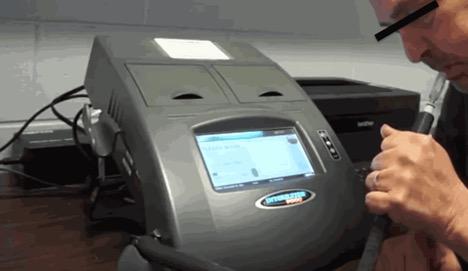
Chemical test results often form the backbone of the state's case. Those results are only as reliable as the steps used to get them.
Breath testing with the Intoxilyzer 9000. Georgia uses the Intoxilyzer 9000 as its state-approved breath testing device. Under Georgia law, breath testing procedures require the machine to be operated with all electronic and operating components properly attached and in good working order. The operator must hold a valid permit from the Division of Forensic Sciences of the Georgia Bureau of Investigation.
Common challenges ask whether the operator watched the driver before testing. The Georgia breath-testing statute sets no fixed observation period. So this goes to how reliable the sample is, not to a statutory violation. The observer watches for burping, vomiting, or anything placed in the mouth. Calibration records and maintenance logs may show that the machine was not working properly at the time of testing.
Georgia law also requires two sequential breath samples. These samples must not differ by more than 0.020 grams in alcohol concentration. If the two readings diverge beyond that threshold, the results may be challenged. The lower of the two results is determinative for both charging and administrative license suspension purposes.
Blood testing. Under Georgia law, blood testing procedures require that only qualified individuals may draw blood. Qualified individuals include a physician, registered nurse, laboratory technician, emergency medical technician, or other qualified person. Chain of custody problems can undermine blood test reliability. Improper use of preservatives or anticoagulants also creates issues. Problems with the headspace gas chromatography analysis can further weaken the prosecution's case.
A driver's refusal to submit to blood or urine testing may be offered as evidence at trial. The Georgia Supreme Court held in Elliott v. State, 305 Ga. 179 (2019), that a breath test refusal may not be used against a defendant at a criminal trial. Refusal still carries license consequences. The fact of a blood or urine refusal becomes evidence.
Many drivers ask how to beat a weed DUI. The answer depends on which part of the DUI statute applies. Georgia prosecutes marijuana DUI cases under two theories.
Under the impairment theory, the state must prove the driver was under the influence of marijuana to the extent it was "less safe" to drive. Unlike alcohol, there is no per se BAC number for THC in the less-safe prong. The state must tie the presence of THC to real impairment. That is a much harder burden to meet.
Under the controlled substance theory, the state can prosecute on any amount of marijuana or its metabolites in the driver's blood or urine. This per se approach does not require proof of impairment. A driver legally entitled to use the drug violates the statute only if rendered incapable of driving safely. It opens a different set of defenses.
Key defense angles in marijuana DUI cases include challenging Drug Recognition Expert evaluations. The 12-step protocol is subjective. It leans hard on the officer's training and judgment. Defense lawyers ask whether the evaluation was done right. They also ask whether the officer's findings hold up in science.
The line between active THC and inactive metabolites matters. Those metabolites can stay in the body for days or weeks after use. Their presence alone does not prove the driver was impaired at the time of driving.
Outcomes in marijuana DUI cases depend on the specific facts, the testing methods used, and the jurisdiction. Drivers facing these charges should consult an attorney who understands the science behind THC testing.
Under Georgia law, implied consent rules require arresting officers to read a set notice when a chemical test is requested. The wording changes with the driver. There is one notice for drivers under 21, one for drivers 21 or older, and one for commercial drivers.
The notice must inform the driver that refusal will result in a minimum one-year license suspension. It must state that refusal to submit to blood or urine testing may be offered as evidence at trial. It must inform the driver of the right to get additional independent testing at their own cost after submitting to the state's test.
The statute requires that the notice be read "in its entirety." The substance of the notice must remain unchanged. If the officer paraphrases, skips portions, or adds misleading language, the resulting consent may be invalid. Defense attorneys review bodycam footage to compare what the officer actually said against the statutory language.
Coercion, confusion, or language barriers can also void consent. Say the driver did not understand the notice because of a language barrier, and no interpreter was there. The consent may not be voluntary.
After arrest, an administrative license suspension may be triggered. You then have only 30 days to act. You can request an ALS hearing, or install an ignition interlock device to keep driving. The interlock permit is open only to drivers 21 and older with no DUI conviction in the past five years. Miss the deadline and the suspension takes effect on its own.
When weighing ways to get out of a DUI conviction, many drivers ask about reduced charges. Where an outright dismissal is out of reach, a negotiated reduction is a common outcome. A reduction to reckless driving – sometimes called a "wet reckless" outcome – avoids many of the harshest consequences.
Reckless driving is a misdemeanor. The penalty is a fine of up to $1,000, up to 12 months in jail, or both. For a driver 21 or older, a reckless driving conviction does not carry the license suspension a DUI conviction requires. It does not require an ignition interlock device. It does not create DUI-specific criminal record consequences. A driver under 21 convicted of reckless driving does lose his or her license by operation of law.
Prosecutors may agree to a reduction when evidence weaknesses make the DUI charge difficult to prove at trial. First-offense cases, borderline BAC results, and procedural errors by law enforcement all strengthen the negotiating position.
Who qualifies for a reckless driving reduction varies by county, by prosecutor, and by the facts of the case. No lawyer can guarantee this outcome. An experienced DUI defense lawyer weighs the evidence and advises whether a deal or a trial is the stronger path.

Refusing a breath or blood test after a Georgia DUI arrest is not always a winning move. Under Georgia law, a refusal triggers a one-year license suspension. That is a civil penalty, separate from the criminal DUI case.
A refusal of blood or urine testing is admissible as evidence against you at trial. Prosecutors regularly argue that refusal shows consciousness of guilt. That inference is not conclusive, but it hands the state one more argument.
You have 30 days from the date the suspension notice is served to challenge the suspension. You may request an ALS hearing. In some cases you may install an ignition interlock device to keep limited driving rights. Miss the deadline and the suspension takes effect on its own.
Refusal does take away one big piece of the state's proof – the chemical test result. Whether that trade helps your case depends on the rest of the evidence. Say officers have strong dashcam video and a damaging field sobriety test. The lack of a test result may not change the outcome. What the driver said also weighs heavily against him.
DUI charges can be beaten in Georgia through several defense strategies. Common routes include challenging the traffic stop, suppressing test results that were not properly obtained, and exposing broken procedures. Some cases end in dismissal. Others are resolved through charge reductions. The outcome depends on the facts of each case, and drivers should ask a lawyer to weigh their options.
Fighting a DUI charge involves filing pretrial motions to suppress evidence. You can challenge how reliable the breath or blood test is. You can also check whether officers followed proper steps during the stop and arrest. A lawyer reviews dashcam video, calibration records, and implied consent compliance to spot weak points. Every case is different, and outcomes depend on the facts.
Effective DUI defenses include proving the officer lacked reasonable suspicion for the traffic stop. You can show that field sobriety tests were given the wrong way. You can challenge Intoxilyzer 9000 results using calibration records, or the fact that no one watched the driver before the test. You can show that the implied consent notice was not properly read. The strongest defense depends on the facts of your own case.
Yes. Georgia prosecutors may agree to reduce a DUI charge to reckless driving when weak evidence makes the DUI hard to prove. For drivers 21 and older, a reckless driving conviction avoids the DUI license suspension and DUI-specific consequences. Who qualifies varies by county and case facts, and no outcome can be guaranteed.
Marijuana DUI defenses focus on challenging proof of impairment, questioning Drug Recognition Expert evaluations, and splitting active THC from inactive metabolites. Under the "less safe" prong, the state must prove real impairment – not just the presence of THC. Blood test steps and chain of custody issues also open defenses. Outcomes depend on the testing methods used and the facts of the case.
If you are asking how to fight a DUI charge, the answer depends on your own stop, arrest, and testing. Every DUI case has its own facts. You need a careful review of the police report, the dashcam and bodycam video, how the field sobriety tests were given, and the Intoxilyzer 9000 or blood test records.
Kohn & Yager LLC offers free DUI case consultations to drivers facing charges anywhere in Georgia. Our attorneys can evaluate your evidence, identify potential defenses, and explain your options. We determine whether a motion to suppress or negotiated reduction may apply to your case.

Call 404-567-5515 any time – 24 hours a day, 7 days a week – to discuss your DUI charge. The sooner you act, the more options stay open. That is doubly true with the 30-day deadline to protect your right to drive.