TOP-RATED
Atlanta Criminal Defense
Law Firm
Atlanta Criminal Defense
Law Firm





Is a DUI considered a felony in Georgia? The answer turns on the offense count and on the harm done. Under Georgia law, a standard charge of driving under the influence is a misdemeanor for the first, second, and third conviction inside a ten-year lookback, and the count crosses the felony line on the fourth conviction in that same ten-year window. Harm can cross that line much sooner, because a collision causing serious injury or a death may be charged as a felony at any offense count. The count-based rule in Georgia therefore remains four convictions in ten years.
This page deals with the penalties that follow a third conviction for driving under the influence. A third conviction inside ten years is not a felony; it is a high and aggravated misdemeanor, and it carries the stiffest sentence Georgia sets for any misdemeanor DUI. The DUI lawyers at Kohn & Yager LLC review every detail of these cases, beginning with the justification law enforcement claimed for the traffic stop. We also look for errors in field sobriety testing, and we examine whether the officer administered the implied consent notice correctly and at the proper moment. Those details can reduce a criminal charge, or eliminate it altogether.

Many callers want a lawyer who will promise "no jail time for 3rd offense DUI," but in Georgia that promise is simply not realistic. Georgia's drunk driving sentencing law sets the term for a third conviction in ten years at 120 days to 12 months. The judge must probate part of that term, but at least 15 days of it is time in a cell, and no judge may suspend those 15 days.
The fine runs from $1,000 to $5,000, and it cannot be probated either. The same sentence adds at least 30 days of community service, a risk reduction course that must be completed within 120 days of the conviction, a clinical evaluation for alcohol or drug use with treatment if that evaluation calls for it, and 12 months of probation, less any days served. That is the floor the law establishes, not the ceiling a judge may reach.

A third DUI is never a felony in Georgia simply because it is the third, because the felony line here sits at the fourth conviction in ten years. Other states draw the line considerably sooner. South Carolina, Michigan, Pennsylvania, and Indiana all treat a third offense as a felony in some cases. In those states a third conviction can bring prison time counted in years, not months.
People often search "what states is a DUI a felony on the third offense?" The list keeps growing, because several states have tightened their repeat offender laws and moved the felony trigger from a fourth offense down to a third, or even a second. Georgia has not followed that trend. Others search "how many DUI are a felony" and get the same answer here: four in ten years.
Has a DUI always been a felony? No, because for decades most states treated impaired driving as a misdemeanor regardless of how many prior convictions a driver had accumulated. Reform laws over the past twenty years changed that in many jurisdictions. That shift is why people now ask "is DUI a felony now." In some states the answer is yes, but in Georgia a DUI remains a misdemeanor through the third conviction, and only the fourth conviction transforms it into a felony.
A guilty verdict on a third charge of driving under the influence brings the harshest sentence Georgia allows for a misdemeanor. The driving rules are where this becomes confusing, because two separate clocks run at once: the sentence runs on a ten-year clock, while the license consequences run on a five-year clock. Compare Georgia DUI penalties for 1st through 4th offenses in our full penalty chart.
Georgia's appellate courts have held that a revocation takes effect when the driver gets actual knowledge or legal notice of it, whichever comes first. A delay by the Clerk of Court in sending the conviction on to the Georgia Department of Driver Services does not push that date back. Lokey v. Georgia Dept. of Driver Services, 291 Ga. App. 856 (2008).
Three convictions in five years, measured from arrest dates, make a driver a habitual violator on that third conviction. The license is revoked, not suspended. If the third offense falls inside ten years but is only the second DUI conviction in the past five years, the result is a three-year suspension instead. That is a hard road, but it is far better than a full revocation.
A third drunk driving conviction inside five years triggers habitual violator status. A conviction of that kind revokes the Georgia license rather than merely suspending it, so the driving record is erased instead of paused and the driver must begin again from nothing.
Revocation procedures set out how the state carries that out. A person may drive again only after the wait runs out and the state lets them re-apply. They must pass the written exam again. They must pass the road test again. Only then does a habitual violator get back behind the wheel in Georgia.
A third charge of driving under the influence brings a very different day in court than a first or a second, because prosecutors treat repeat cases far more aggressively and judges expect the defense to arrive fully prepared.
The case starts with arraignment, where the defendant enters a plea. On third-offense cases, courts rarely put an early deal on the table. Discovery comes next, and the defense reads the arrest report, reviews dashcam and bodycam footage, and obtains the breath or blood test results together with the officer's notes on the field tests. Discovery matters here because the state still has to prove every element beyond a reasonable doubt.
Motions are where a seasoned defense lawyer often gains ground. One motion asks the court to suppress the stop itself, on the ground that law enforcement lacked a reason to pull the car over, while another attacks the implied consent notice and whether the officer read it fully and at the right moment. A third motion challenges the breath test results using the machine's own repair and calibration records. A motion that lands can knock out the state's best evidence and force a plea to something smaller.
Plea negotiations also look different on a third charge, because prosecutors know the floor the law sets and often push well above it. DUI Court can be another road, where a county operates one. These accountability courts let repeat offenders serve less time in exchange for close supervision, counseling, and regular testing. Smaller counties may route a defendant to Drug Court in Superior Court instead.
Anyone facing a third charge also has the right to appeal the license suspension on the administrative side, and that appeal can be worth filing for the criminal case as well, in the right hands. Because a 4th DUI in Georgia within a ten-year span is a felony, a third conviction is the last one that stays a misdemeanor. The stakes match that.

Both clocks matter, and they perform different jobs. The ten-year clock establishes the criminal charge, because a third conviction inside ten years is a high and aggravated misdemeanor, and both windows are measured from arrest dates. The five-year clock governs the driving loss, because three convictions inside five years make the driver a habitual violator, and the license is revoked for five years.
The five-year clock also brings the newspaper notice, because on a second or later conviction inside five years the clerk publishes a notice of conviction, together with the driver's arrest photo, in the county legal organ. The driver pays a $25 fee for it at sentencing.
Holding a license issued under another name does not undo habitual violator status, and the Georgia Court of Appeals rejected that defense in Munna v. State, 331 Ga. App. 410 (2015). A valid license, the court held, means one held by a former habitual violator whose driving privilege has been restored.
The high and aggravated label also changes how the time is actually served, because a person serving that kind of misdemeanor sentence earns no more than four days of credit a month. Good time therefore barely moves the release date at all.
Georgia sets the term for a third conviction in ten years at 120 days to 12 months, and the judge must probate some of it. At least 15 days must be served in custody, and that portion is fixed. Many courts go well past that floor and hand down 60 to 90 days or more, because a prior DUI conviction changes how even otherwise reasonable judges evaluate a case.
A third conviction inside ten years may bring the following:
Georgia does not allow a conviction for driving under the influence to be restricted or expunged, so it remains on the record permanently. The weight of it reaches well past the jail time and the community service hours.
A third conviction for driving under the influence inside ten years is a high and aggravated misdemeanor. That label is not a felony charge, and the gap between the two is wide: the term still tops out at 12 months, it is served in county jail rather than in state prison, and it does not strip civil rights the way a felony conviction does.
What the label does change is the money and the time actually served. The fine can reach $5,000, and earned time is capped at four days a month, so a driver handed the full 12 months remains in custody for close to the whole year. Many people hear "high and aggravated" and assume they have been charged with a felony, but they have not.
A fourth conviction in ten years is Georgia's felony line, and it carries one to five years in state prison, though a judge may suspend or probate all but 90 days of that term. The fine again runs from $1,000 to $5,000, and the sentence adds 60 days of community service and five years of probation, less any time served. A felony record also costs a person the right to own a firearm, and it can jeopardize a professional license.
The step from a third charge to a fourth is the widest one in Georgia DUI law, and anyone charged with a DUI for the third time should understand that a conviction now creates felony exposure on the next arrest. Our partners have taken on repeat cases well past that point, including a published Athens case report for a driver facing an eighth lifetime DUI.
What is the license suspension for a third DUI? Older traffic convictions matter here, and so do alcohol offenses committed before the driver turned 21. Drug charges and marijuana charges on the record can disqualify a person from a probationary license, and any driver who does qualify for one may be required to install an ignition interlock device and keep it serviced. That runs somewhere between $70 and $120 a month, on top of everything else.
A third conviction for driving under the influence inside five years brings a five-year revocation, and no limited permit is available during the first two years. Drivers often call that stretch a hard suspension, and the description fits. After two years have passed since the license was surrendered, a driver may request a probationary license, but the conditions are demanding. The risk reduction course, which most people call DUI school, must be completed, as must a clinical evaluation for alcohol and drug dependency, along with whatever additional steps that evaluation recommends.
A third charge of driving under the influence inside five years can also bring heavy fines and surcharges, and so can a third one inside ten. Judges hold wide discretion at sentencing, and in many courts the jail time is entirely real. Our lawyers look for creative answers in repeat offender cases, because the standard answers rarely help. Our firm's DUI legal professionals have worked with repeat offenders in Georgia since 1976.
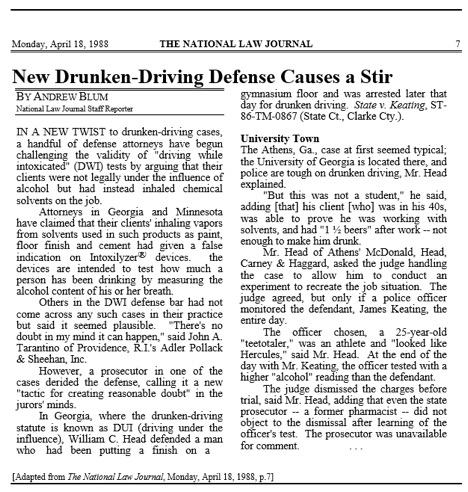
Our law partners co-author The Georgia DUI Trial Practice Manual, a reference written for Georgia DUI defense lawyers, prosecutors, and judges. Mr. Head also wrote a book called "101 Ways to Avoid a Drunk Driving Conviction" in 1991. The cases our firm has handled over the years reflect that same approach.
In Georgia the penalties for a third DUI are severe, and the General Assembly wrote them that way to push repeat offenders off the road. A conviction of this kind reaches your job, your family, your finances, and your future. If there is a way to win the case, our lawyers want to hear about it. The first consultation is free, and most clients can be offered a payment plan that works for them. Call any hour of any day at 404-567-5515.

Georgia treats a standard DUI as a misdemeanor, and that classification covers the first, second, and third conviction inside a ten-year lookback. The third one is a misdemeanor of a high and aggravated nature, which is still a misdemeanor. People ask "is DUI a felony now" because other states have moved their felony line, but Georgia has not moved its own, and here the count alone does nothing until the fourth conviction lands.
Harm is the other road to a felony, and it does not wait for a count. A crash that causes serious bodily injury to another person can be charged as serious injury by vehicle, a felony that carries one to 15 years. A crash that kills can be charged as first degree vehicular homicide, a felony that carries three to 15 years. Child endangerment counts can stack as well, one for each child under 14 in the car.
So is getting a DUI a felony? Not on its own, and not on the count alone until a fourth conviction, because the answer turns on what happened on the road and on how many prior convictions sit inside the window. Anyone charged should ask a lawyer what their own facts do to the charge.
A high and aggravated misdemeanor is still not a felony, and it carries up to 12 months in county jail. A felony conviction means state prison, forfeited civil rights, and a permanent record that follows a person for life. That difference should shape how a defendant weighs a plea against a trial.
Is first DUI a felony? In most cases the answer is no, because nearly all first offense DUI cases in Georgia are charged as misdemeanors. A first conviction carries a fine of $300 to $1,000, and the term runs from 10 days to 12 months, though a judge may suspend all but 24 hours of it when the breath or blood reading is 0.08 or higher. It adds at least 40 hours of community service and 12 months of probation, less any days served. The license is suspended for 12 months, and a driver may seek reinstatement after 120 days once DUI school is done and the fee is paid.
There are narrow roads to a felony on a first arrest. If the collision causes serious bodily injury, the driver can face a serious injury by vehicle count, and if someone dies, first degree vehicular homicide applies. Neither charge depends on a prior DUI conviction, because both depend entirely on the harm done.
Child endangerment adds another layer, because Georgia treats each child under 14 in the car as a separate count. Depending on how many children were in the vehicle, the exposure can run well past an ordinary misdemeanor. Anyone arrested, even on a first charge, should find out what the real counts are before deciding anything.
Georgia has four triggers that move a DUI from misdemeanor to felony, and knowing which one is in play tells a person what they are really facing.
Fourth conviction in ten years. A fourth conviction for driving under the influence inside a ten-year window is a felony. The range is one to five years in state prison, and a judge may probate all but 90 days. The fine reaches $5,000, and the window is measured from arrest dates rather than conviction dates.
Serious injury by vehicle. A driver who causes serious bodily injury to another person while impaired faces a felony that carries one to 15 years, and a prior record has nothing to do with it.
Vehicular homicide in the first degree. A death caused by an impaired driver can be charged as first degree vehicular homicide, a felony carrying three to 15 years, and even a first-time driver can face that charge if the collision proves fatal.
Driving as a habitual violator. A person whose license was revoked as a habitual violator and who drives anyway commits a felony on its own, and it carries one to five years. A DUI on top of that only deepens the hole.
The count-based answer stays simple: four convictions in ten years. But injury, death, or habitual violator status can make any DUI a felony, including a first one. Every case turns on its own facts, so an early conversation with a defense lawyer is the fastest way to learn which rule applies.
A third DUI charge in Georgia brings jail time you cannot avoid, the loss of your license, and fallout that reaches every part of your life. If a fourth conviction would trigger felony exposure, the stakes climb higher still.
During a free first consultation at Kohn & Yager LLC, our attorneys read the arrest report, examine the breath or blood evidence, and test the traffic stop for constitutional problems. We then discuss realistic options based on your record and the particular facts of your case. Getting a lawyer in early matters, because the sentencing floor Georgia sets leaves almost no room to fix things after a conviction.
No attorney can promise a specific outcome, because every DUI case turns on its own facts and on the evidence at hand. What we can do is fight to protect your rights, test weak evidence, and pursue every defense the case offers.
Our DUI attorneys answer the phone 24 hours a day, 7 days a week. Contact our Georgia criminal defense attorneys for a free case review by calling 404-567-5515.

A standard DUI in Georgia is a misdemeanor for the first, second, and third conviction inside ten years, and the third one is a misdemeanor of a high and aggravated nature. A DUI becomes a felony on the fourth conviction inside ten years, or when it causes serious injury or a death.
A DUI becomes a felony in Georgia on the fourth conviction inside a ten-year lookback, and it may also be charged as a felony at any offense count when the collision causes serious injury or results in a death.
In most cases, no, because a first DUI in Georgia is charged as a misdemeanor. The exception is a collision that causes serious bodily injury to another person or results in a death, and in those cases the driver may face felony DUI charges regardless of what the prior record looks like.
Four convictions inside a ten-year period make the fourth offense a felony in Georgia, and the window is measured from arrest dates. A third conviction remains a misdemeanor, though a high and aggravated one, carrying a considerably harsher sentence than a first or second.
Only if the DUI was charged and convicted as a felony, because a misdemeanor conviction, whether first, second, or third, does not make you a convicted felon. A fourth conviction inside ten years does, and so does a DUI involving serious injury or death. That felony record carries every consequence a felony carries.