TOP-RATED
Atlanta Criminal Defense
Law Firm
Atlanta Criminal Defense
Law Firm





Drivers who search for a felony DWI 3rd offense usually find rules from another state. Georgia works differently. When you are arrested for a third DUI offense here, the stakes rise sharply. Under Georgia law, a 3rd DUI within a 10-year lookback period is classified as a high and aggravated misdemeanor. This carries significantly harsher penalties than a standard misdemeanor. Beyond the courtroom, expect DUI insurance rates to rise sharply. Your first court appearance after a third DUI arrest is the arraignment. Our guide to what an arraignment hearing is explains what happens there and how to enter a plea.
Many people ask, "What happens after 3 DUIs?" The answer depends on timing. Georgia measures the 10-year window from arrest date to arrest date, not from conviction dates. If your three arrests fall within that window, you face enhanced third-offense penalties. If your third arrest falls outside the 10-year lookback, it may be treated as a lesser offense. The court still sees your full record.
A 3rd DUI in Georgia triggers collateral consequences beyond criminal penalties. A notice of conviction carrying your arrest photo runs in the county legal organ on a second or later conviction within five years. The Georgia Department of Driver Services declares you a habitual violator when three convictions fall within five years. You may also face difficulty with employment, housing, and professional licensing.
A 3rd DUI within 10 years is a high and aggravated misdemeanor. Georgia measures this using arrest dates, not conviction dates. The law mandates minimum jail time, and a vehicle driven by an already-declared habitual violator who is arrested again for DUI can be forfeited. You face a sentence of 120 days to 12 months, with at least 15 days served in actual jail. Fines range from $1,000 to $5,000. Accountability courts may convert some jail days to other tasks. If all three convictions fall within five years, your license is revoked for 5 years. Only then are you declared a habitual violator; if the earlier convictions are older than five years, the license suspension runs 12 months or 3 years. An experienced attorney from Kohn & Yager LLC may help you avoid the harshest penalties or challenge the charges entirely.
One common question is, "How long do you go to jail for a 3rd DUI?" Georgia law sets clear minimums and maximums.
Minimum time actually served: 15 days (mandatory – a judge cannot waive this), inside a sentence of at least 120 days.
Maximum jail sentence: 12 months in county jail.
The judge must probate at least a portion of that sentence, so the remainder is served on probation. The 15-day minimum must be served behind bars.
In practice, many third-offense DUI defendants serve between 15 and 90 days. The length depends on the facts of the case, the county, and the judge. Aggravating factors include an accident, a high BAC, or a minor in the vehicle. These can push the sentence toward the maximum.
Jail exposure climbs at every offense level. A first DUI carries a range of 10 days to 12 months, with a 24-hour floor only when the BAC was 0.08 grams or more. Below 0.08, the judge may suspend, stay, or probate the entire term. A second DUI within 10 years carries 90 days to 12 months with a 72-hour mandatory minimum actually served. Courts are far more likely to make second offenders serve real time. A second conviction also adds 30 days of community service. A third within 10 years carries the 15 days no judge may waive.
Several factors drive the actual outcome. These include the BAC number, whether anyone was hurt, and whether the driver refused testing. Your prior record matters. The assigned county matters. The assigned judge matters. Accountability courts also matter. In metro Atlanta counties, DUI court placement can convert part of a sentence into treatment, testing, and reporting. Eligibility and availability vary by circuit.
Anyone asking whether a first or second DUI means jail should treat these ranges as starting points, not predictions.

People who search "what is a felony DWI" usually find rules from states where a third drunk driving conviction is a felony by default. In a number of other states, a third drunk driving conviction is charged as a felony by default. The label "felony DWI 3rd offense or more" describes the norm in those places. A felony conviction in those states can mean years in state prison, loss of voting rights, and a permanent felony record.
Georgia does not follow that model. Under Georgia's DUI statute, a third DUI within 10 years is a high and aggravated misdemeanor – not a felony. The high and aggravated misdemeanor sentencing law caps confinement at 12 months and the fine at $5,000. Good-time credit is limited to four days per month. Defendants therefore serve a much larger share of their sentence than they would on an ordinary misdemeanor.
Despite carrying a misdemeanor label, the penalties are severe. The 15-day mandatory minimum jail sentence cannot be waived. When three convictions fall within five years, the Department of Driver Services declares you a habitual violator and revokes your license for 5 years. On a second or later conviction within five years, a notice of conviction carrying your arrest photo runs in the county legal organ.
So is a DWI a felony in Georgia? Not at the third offense. Georgia does not even use the term "DWI." The offense is called driving under the influence. A Georgia DWI charge is a DUI charge, and the same law controls the penalties. Whether calling a DWI a felony is accurate depends entirely on which state is prosecuting.
Georgia reaches felony territory in three situations. First, a 4th DUI within 10 years is a felony carrying 1 to 5 years in state prison. Second, serious injury by vehicle is a felony punishable by 1 to 15 years when a DUI-related accident causes bodily harm as defined by statute. Third, vehicular homicide carries 3 to 15 years when a DUI causes someone's death. These felony charges can apply to a first arrest if the facts support them. The prosecutor's charging decision and the circumstances of the crash control whether a case moves to felony territory.
This distinction matters most for people who moved to Georgia from a state that treats a third offense as a felony. The penalties for a third DUI here – mandatory jail, plus habitual violator status and a 5-year license revocation when the three convictions fall within five years – rival felony-level consequences in practice. But the charge itself remains a misdemeanor. Out-of-state penalty information may not describe your exposure here. Anyone comparing charges across state lines should consult a Georgia DUI attorney about the facts of their arrest.
What other states call a DWI is a DUI in Georgia, and it is a crime, not a traffic violation. Clients often ask, "Is a DWI a crime?" Others ask, "Is a DWI a traffic violation?" Many hope the charge works like a speeding ticket. It does not.
Georgia treats ordinary moving violations as minor traffic matters. You pay a fine, take the points, and the case ends. Driving under the influence is different. Under Georgia law, it is a criminal charge. The offense is prosecuted in state, superior, municipal, or recorder's court. The charge carries the possibility of jail and creates a permanent criminal record. Employers and landlords see this record on background checks.
Driving under the influence is a criminal offense in Georgia, not a ticket. The practical differences show up right away. Officers fingerprint and book a DUI arrestee. The case moves through court like any other criminal prosecution, with an appearance to enter a plea. No one may mail in a payment and move on.
Once a court enters a DUI conviction, Georgia law does not allow it to be restricted or expunged. That matters directly to a third charge. Because every DUI is a criminal conviction rather than a ticket, each one stays on your record permanently. Each one counts toward the 10-year lookback that turned this arrest into a high and aggravated misdemeanor.
Georgia imposes a comprehensive set of penalties for a third-offense DUI conviction:
| Penalty | Consequence |
|---|---|
| Jail Time | 120 days to 12 months; 15 days mandatory actual incarceration |
| Fines | $1,000 to $5,000 (plus surcharges) |
| Probation | 12 months less any days actually served on the DUI offense |
| Community Service | Not fewer than 30 days of community service |
| License Revocation | 5-year revocation as a habitual violator when 3 convictions fall within 5 years |
| Clinical Evaluation | Mandatory clinical evaluation; treatment program if the evaluation recommends it |
| DUI Risk Reduction Course | Must be completed within 120 days of conviction, and before re-licensing |
| Newspaper Publication | Notice of conviction with arrest photo, on a 2nd or later conviction within 5 years |
| Ignition Interlock Device | Required to reinstate after a 2nd DUI conviction within 5 years |
| Vehicle Forfeiture | Vehicle driven by a declared habitual violator arrested again for DUI is subject to forfeiture |
Beyond these formal penalties, a 3rd DUI punishment often includes increased insurance costs. An SR-22 filing may be required as proof of financial responsibility. Difficulty finding employment is common. Non-citizens may face immigration consequences.
Georgia sentences every 3rd DUI within 10 years on the same criminal tier under the statute. The license side is different: three convictions inside 5 years bring habitual violator status and a 5-year revocation, which three spread across 10 years do not. But the practical impact differs significantly.
Three DUIs in a shorter time frame signals a pattern. Judges and prosecutors take this very seriously. This often results in sentences closer to the 12-month maximum.
Three DUIs spread across 8 to 10 years may allow your attorney more room to argue for leniency and rehabilitation.
If your 3rd arrest falls outside the 10-year lookback window, it is treated as a first offense for sentencing purposes. The judge will still be aware of your record. The lookback period is measured from arrest date to arrest date, not from conviction date. This distinction is critical. An experienced DUI attorney will verify this immediately.
Complete avoidance of jail after a 3rd DUI conviction is impossible. The 15-day mandatory minimum cannot be waived upon conviction. But strategies exist to minimize exposure or avoid conviction altogether.
Challenge the traffic stop. If the officer lacked reasonable articulable suspicion to initiate the stop, all evidence gathered afterward may be suppressed. Without admissible evidence, the case falls apart.
Challenge the field sobriety tests. Standardized field sobriety tests come from NHTSA training standards rather than any Georgia statute. Deviations in administration undermine their reliability. These include wrong instructions, uneven surfaces, and medical conditions.
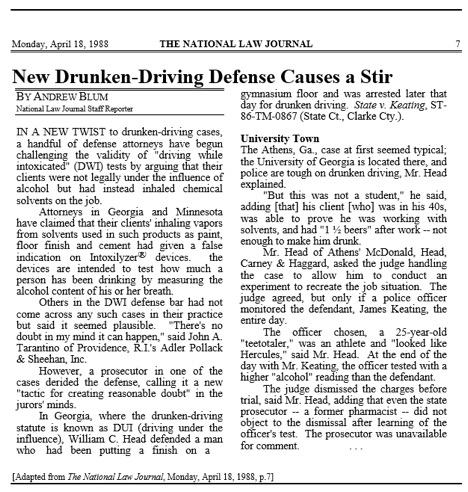
Challenge the breath or blood test. Georgia uses the Intoxilyzer 9000, urine tests, or blood draw procedures. Georgia law requires the test to be run on an instrument approved by the GBI Division of Forensic Sciences by an operator holding a valid permit. Machine calibration matters. Chain of custody matters. Proper sample storage matters. Improper blood draw procedures matter. GBI errors in testing and tracking samples matter. For breath testing, failure to observe the 20-minute deprivation period matters. Any of these can be grounds for suppression.
Challenge prior convictions. For the state to sentence you as a third offender, constitutional case law – not a Georgia statute – requires it to show the two prior DUI convictions were validly obtained. If a prior conviction was obtained without proper counsel or contained procedural defects, it may not count.
Negotiate a reduction. In some cases, an experienced attorney can negotiate a reduction to reckless driving or a first-offense DUI. This eliminates the mandatory 15-day jail minimum.
The key takeaway: avoiding jail for a 3rd DUI in Georgia requires aggressive, skilled legal defense – not hoping for the best.
A 3rd DUI conviction within five years in Georgia triggers a 5-year hard revoke of your driver's license. You will also be declared a habitual violator. Driving before the department reissues a license, or before those five years run, is a felony.
After 2 years of the revocation period, you may apply for a probationary license if you meet certain conditions.
First, you must complete a DUI Alcohol or Drug Use Risk Reduction Program or an approved defensive driving course. Second, you must have gone those two years without a conviction for any moving violation. Third, you must swear an affidavit that you do not excessively use alcohol or illegally use controlled substances. Fourth, you must pay a $210 probationary license fee, submit proof of financial responsibility, and show that refusal would cause extreme hardship.
Driving as a habitual violator – even to work or a medical appointment – is a felony punishable by 1 to 5 years in prison. This makes it critical to pursue every legal option for maintaining or restoring limited driving privileges.
Georgia does not sort misdemeanors into lettered or numbered classes. Drivers who search "what class of misdemeanor is a DUI" expect a Class A or Class B answer. No such label exists here.
Georgia uses two tiers instead. An ordinary misdemeanor carries up to 12 months and a fine up to $1,000. A misdemeanor of a high and aggravated nature carries the same 12-month ceiling. The fine rises to $5,000.
The high and aggravated label changes more than the fine. Good-time credit is capped at four days per month rather than the standard rate. A defendant therefore serves a much larger share of whatever sentence the judge imposes. For this reason, a high and aggravated year is far heavier than the number suggests.
The DUI tiers line up this way. A first or second DUI within 10 years is an ordinary misdemeanor. A third within 10 years is a misdemeanor of a high and aggravated nature. A fourth within 10 years becomes a felony.
Terms like "DWI misdemeanor B" have no Georgia equivalent. Penalty ranges published for other states will not match what a Georgia court may impose. Anyone comparing charges across state lines should ask a Georgia DUI attorney about the facts of their own arrest.
Many people facing a second DUI arrest ask, "Will I go to jail for second DUI?" A conviction makes jail very likely. Georgia law sets a 72-hour mandatory minimum for a second DUI conviction within 10 years. No judge may waive those 72 hours upon conviction.
The chances of going to jail for second DUI depend on the facts of the case and the county where the arrest occurred. Several factors push the sentence higher than the 72-hour floor.
A BAC well above 0.08 signals a greater risk to public safety. Prosecutors use that number in sentencing arguments. An accident – especially one with injuries – increases exposure significantly. Refusal of chemical testing after arrest may also work against a defendant at sentencing. Prosecutors in Fulton, DeKalb, Gwinnett, and Cobb counties each handle second offenses with different priorities. The same facts may produce different outcomes depending on jurisdiction.
In practice, most second-offense defendants who are convicted serve between 72 hours and several weeks. Sentences closer to the 12-month maximum are possible but less common absent aggravating circumstances. Accountability court programs and DUI court placement can change how that time is served. These programs may convert a portion of jail days into supervised treatment, random testing, and regular court check-ins. Eligibility depends on the judicial circuit and the defendant's history.
A defense attorney may challenge the legality of the traffic stop. They may also work to suppress breath or blood test results. Negotiating a reduction to reckless driving is another option. A reduction to reckless driving means there is no DUI conviction, so the 72-hour minimum does not apply.
The strength of these defenses depends on the specific facts of your case. This includes the officer's stated reason for the stop, how the field sobriety tests were given, and whether testing protocols were followed.
A person convicted of a second DUI should understand that a third arrest within 10 years carries dramatically greater exposure. A third offense brings a 15-day mandatory minimum, plus habitual violator status and a 5-year revocation when all three convictions fall within five years.
A 3rd DUI in Georgia brings mandatory jail, plus a 5-year revocation as a habitual violator when all three convictions fall within five years. The criminal case is only half the problem. A separate 30-day administrative deadline runs from the date you are given notice of the suspension. You must file the written hearing request, with the $150 filing fee, with the Department of Driver Services within that window. If you do not, the suspension may take effect long before the criminal charge is resolved.
At Kohn & Yager LLC, our Atlanta DUI attorneys have handled hundreds of DUI cases across Georgia. We have experience with high and aggravated third offenses. A free consultation covers the stop itself. We review how the field sobriety tests were given. We examine how the breath or blood testing was performed. We verify whether the prior convictions the State wants to count toward the 10-year lookback are actually valid. We answer the phone 24 hours a day, 7 days a week and offer payment plans.
No lawyer can promise a dismissal, a reduction, or any particular sentence. Past results do not guarantee a similar outcome. What we can do is examine every issue in the case and pursue every available defense.

No. In many states, a felony DWI 3rd offense or more is automatic for a third drunk driving conviction. Georgia does not follow that rule. Here, a 3rd DUI within 10 years is a high and aggravated misdemeanor – not a felony. Felony status attaches at the 4th DUI within 10 years, or when a DUI-related accident causes serious injury or death. Despite the misdemeanor label, the penalties are severe. A third-offense conviction carries a 15-day mandatory minimum in jail. It also brings fines up to $5,000, plus a 5-year revocation as a habitual violator when all three convictions fall within five years. These consequences rival felony-level penalties in other states.
A 3rd DUI within 10 years in Georgia is a high and aggravated misdemeanor. A 4th DUI within 10 years is a felony.
A third-offense DUI conviction brings a sentence of 120 days to 12 months, with 15 days of mandatory actual jail. Fines range from $1,000 to $5,000. If all three convictions fall within five years, you lose your license for 5 years as a habitual violator. At least 30 days of community service follows, plus a published notice of conviction on a second or later conviction within five years.
The mandatory minimum actually served is 15 days, inside a sentence of at least 120 days. The maximum is 12 months. Most sentences fall somewhere in between depending on the facts and the jurisdiction.
You cannot avoid jail if you are convicted – the 15-day minimum is mandatory. But your attorney may be able to get the charges reduced or dismissed. This would eliminate the mandatory jail requirement.
Your third arrest may be sentenced as a first offense for statutory purposes. The judge will still be aware of your record.
Yes, Georgia treats them the same. Georgia never charges "DWI." The offense is called driving under the influence under Georgia law. A DWI arrest here is a DUI arrest. A prior conviction from a DWI state may still count toward Georgia's 10-year lookback. The determination depends on how that offense compares to Georgia law.
Georgia charges it as DUI, and it is a criminal offense, not a traffic ticket. Unlike a speeding ticket, a DUI charge means booking, fingerprints, a required court appearance, and possible jail. A conviction creates a permanent criminal record that background checks reveal. Georgia law does not allow that conviction to be restricted or expunged.
Georgia has no lettered misdemeanor classes. A first or second DUI within 10 years is an ordinary misdemeanor. A third within 10 years is a misdemeanor of a high and aggravated nature. The maximum fine rises to $5,000. Good-time credit is limited.
Georgia uses "DUI" rather than "DWI," but the terms describe the same offense. A DUI becomes a felony in Georgia in three situations.
First, a 4th DUI within 10 years is a felony carrying 1 to 5 years in state prison. Second, serious injury by vehicle is a felony punishable by 1 to 15 years when a DUI-related accident causes bodily harm as defined by statute. Third, vehicular homicide carries 3 to 15 years when a DUI causes someone's death.
Many other states classify the 3rd offense as an automatic felony. Georgia does not. The third offense here is a high and aggravated misdemeanor. Charging decisions for felony-level offenses rest with the prosecutor and depend on the facts of the case.
The chances of going to jail for a second DUI are high if you are convicted. Georgia law requires a 72-hour mandatory minimum for a second conviction within 10 years. No judge may waive that time. The sentence may exceed 72 hours based on BAC level, whether there was an accident, and whether you refused testing. The county where the case is heard also matters.
Reducing or avoiding jail may be possible if a defense attorney can challenge the stop or suppress test results. You may also negotiate a plea to a lesser charge like reckless driving. Speak with a Georgia DUI attorney about the specific facts of your case.