TOP-RATED
Atlanta Criminal Defense
Law Firm
Atlanta Criminal Defense
Law Firm





By: William C. Head, Georgia Criminal Defense Attorney and Atlanta DUI Lawyer Since 1976
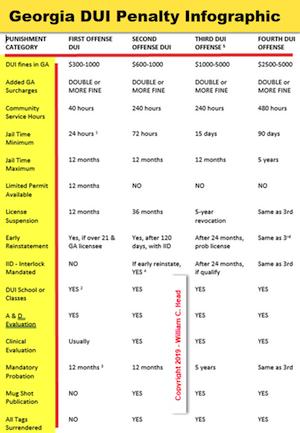
Atlanta DUI penalties are governed by Georgia law, which sets criminal punishments that increase with each conviction over a 10-year look-back period. A first offense carries up to 12 months in jail and fines up to $1,000. A second offense raises the mandatory jail minimum to 72 hours. A third offense is a high and aggravated misdemeanor with at least 15 days in jail. A fourth DUI in Georgia is a felony carrying one to five years in state prison.
Need answers tonight? Call (404) 567-5515 at any hour for a FREE lawyer consultation with a co-author of the leading law book on Georgia DUI laws. Our criminal defense law firm can be reached 24 hours a day.
Not every consequence follows the same timeline. Several license-related consequences include a three-year license suspension, habitual-violator revocation, newspaper publication of the conviction, and license plate surrender. These use a shorter five-year look-back under Georgia law. A second DUI that falls six to ten years after a prior arrest still triggers enhanced criminal penalties. But it may carry only a 12-month license suspension rather than a three-year suspension.
This article walks through each offense tier and states the specific look-back window that governs each consequence. A full survey of the Georgia DUI laws shows how these statutes fit together. Getting a precise DUI definition requires understanding the different subsections of the statute, since each describes different prohibited conduct. The consequences for DUI extend well beyond criminal law DUI penalties. They also include administrative license actions controlled by Georgia's implied consent laws. This page focuses on the criminal penalties and the license consequences tied to each offense level.
Several Georgia statutes work together to define DUI offenses, set criminal penalties, and impose license consequences. Understanding which statute controls which consequence is critical because the look-back periods differ.
DUI offenses and criminal penalties define the DUI offense itself and establish criminal penalties by offense count within a 10-year look-back. This statute covers DUI less safe, DUI per se, and DUI involving drugs or other substances. It also requires newspaper publication for a second or later conviction within five years.
License suspension periods set the license suspension that follows a DUI conviction by operation of law. The suspension length depends on the number of convictions within the preceding five years – not ten. A common mistake is confusing this five-year window with the ten-year look-back that controls criminal sentencing.
Ignition interlock permits establish the ignition interlock device limited driving permit. For a second DUI conviction within five years, a driver may apply for an interlock permit after serving at least 120 days of the suspension. The driver must surrender the license and show either a certificate of eligibility from an accountability court or proof of enrollment in a substance abuse treatment program. The department does not issue this permit to a driver under 21.
Habitual violator status follows three convictions within a five-year period. The department revokes the license by operation of law for five years, and the driver may not operate any motor vehicle during that period. For a driver whose status came from three DUI convictions, driving during the revocation is the felony of habitual impaired driving, punishable by a fine of at least $1,000 or one to five years in prison, or both. A probationary license may become available two years after the license is surrendered.
License plate surrender requires the court, on a second or subsequent DUI conviction within five years, to order the plates of every vehicle registered in the driver's name surrendered to the court. The court forwards them to the local tag agent, and the commissioner revokes each plate.
A separate rule governs license suspensions for drug-related DUI convictions; it does not control alcohol-DUI suspensions. Court scheduling also affects the outcome, and our explanation of how long a DUI case takes in Georgia covers each stage.
For both the criminal and license look-back periods, the controlling factor is the date of arrest to date of arrest – not the date of conviction.
Georgia law recognizes two primary methods of charging a DUI, and prosecutors may pursue both theories in the same case.
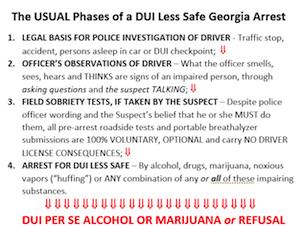
DUI less safe requires the State to prove that the driver was under the influence of alcohol to the extent that it was less safe for that person to drive. The prosecution builds this case through field sobriety test performance, driving behavior, officer observations, and other circumstantial evidence. No specific blood alcohol level is required. What matters is whether the alcohol made the driver less safe behind the wheel.
DUI per se requires the State to prove the driver's alcohol concentration was 0.08 grams or more at any time within three hours after driving, from alcohol consumed before the driving ended. A commercial motor vehicle operator commits a separate misdemeanor at 0.04 percent or more by weight of alcohol in the blood, breath, or urine. For drivers under 21, the limit is 0.02 grams. A charge under this subsection does not require proof that the driver was actually impaired. The BAC reading alone satisfies the element. How a reading translates into the legal alcohol level from a BAC chart depends on body weight, sex and how fast the drinks were consumed, which is why the State still has to prove the reading itself.
Both charges can be brought in a single case, giving prosecutors two paths to conviction. The consequences of a DUI conviction are the same regardless of which theory the jury accepts.
Underage drivers face a separate charging framework described on our underage DUI charges page.
Marijuana and DUI: Although Georgia law prohibits driving with any amount of marijuana in the driver's blood or urine, marijuana is not a per se DUI offense in practice. The Georgia Supreme Court held in Love v. State, 271 Ga. 398 (1999), that the prosecution must prove the driver was rendered a less-safe driver by the marijuana. Simply having THC or its metabolites in the blood does not, by itself, establish guilt.
A first DUI conviction in Georgia is a misdemeanor. The criminal penalties apply when the driver has no prior DUI conviction or nolo contendere plea within the preceding ten years. Time is measured from arrest date to arrest date.
These penalties for drinking and driving apply statewide, including to arrests in Towns County and throughout metro Atlanta.
A first DUI conviction triggers a 12-month license suspension under Georgia law. A driver with no prior DUI conviction within five years may apply for a limited driving permit immediately after conviction, once the license has been surrendered to the court. The department issues that permit, for a $32 fee, if refusing it would cause extreme hardship as the statute defines it. At the end of 120 days, the driver may apply for early reinstatement.
The driver must complete the Risk Reduction Program. The driver must also pay a reinstatement fee of $210 (or $200 if paid by mail) at a Georgia DDS office.
A DUI conviction in Georgia cannot be expunged or sealed, and record restriction is not available for a serious traffic offense conviction. The First Offender Act does not apply to DUI charges under Georgia law. The conviction remains on the driver's record permanently.
A second DUI conviction within ten years remains a misdemeanor, but the criminal penalties increase substantially. Several license and ancillary consequences also follow a separate five-year look-back. The timing of the second arrest relative to the first determines which license penalties apply.
These penalties apply to any second DUI conviction within ten years:
If the second DUI arrest falls within five years of the prior arrest, the following additional consequences apply:
A second DUI that falls outside the five-year window but within ten years still triggers the enhanced criminal penalties above. For license purposes, the driver is treated as a first offender. The driver faces only a 12-month suspension under Georgia law, with no interlock requirement, no newspaper publication, and no plate surrender.
Clients facing a second DUI in Georgia often do not realize these two look-back windows produce different results. Understanding the Implied Consent Notice given at the time of arrest is also critical to preserving license rights.
A third DUI conviction within ten years is classified as a high and aggravated misdemeanor under Georgia law. This classification carries harsher sentencing rules than a standard misdemeanor.

When the third conviction falls within five years of two prior convictions, the consequences are severe:
The jail time exposure alone on a third offense makes early legal consultation critical.
A fourth DUI in Georgia within ten years is a felony under Georgia law. This is the most serious DUI classification in Georgia and carries state prison time rather than county jail.

A fourth DUI conviction within ten years does not automatically meet the five-year thresholds. These license consequences apply only when the prior convictions the statute counts also fall within five years of the current arrest:
A DUI felony conviction carries consequences beyond the criminal sentence. Felons lose the right to possess firearms under both Georgia and federal law. Non-citizens may face deportation or inadmissibility proceedings. Professional licenses in healthcare, education, law enforcement, and other fields may be revoked or denied.
Some repeat-offense DUI cases may qualify for a DUI Court or Drug Court alternative. A court with jurisdiction over drug cases may establish a drug court division as an alternative to the traditional judicial system. The Council of Accountability Court Judges sets standards and practices for these programs. A judge in one of these programs may not impose, modify, or reduce a sentence below the minimum the law requires. A certificate of eligibility from an accountability court can support an application for an ignition interlock device limited driving permit.
A DUI conviction in Georgia stays on your record permanently. No record restriction is available, and the First Offender Act does not apply to DUI charges. A DUI conviction can result in jail time, fines, license suspension, and a permanent criminal record. The consequences of DUI conviction are not limited to the courtroom. They affect employment, insurance, and daily life for years.
Our Atlanta DUI defense attorneys at Kohn & Yager LLC focus on defending DUI cases under Georgia law throughout Fulton County and metro Atlanta. Each case depends on the specific facts and the evidence available. This is true whether the charge involves a traffic stop in Atlanta, a breath test refusal, or a repeat offense. Some people searching for an Atlanta Georgia DWI are looking for these same DUI penalties.
Call (404) 567-5515 for a free consultation. We are available 24 hours a day, seven days a week.

Yes, you can go to jail for a DUI. Georgia law sets a jail minimum the judge cannot suspend for a second, third or fourth conviction, and for a first conviction when the driver's alcohol concentration was 0.08 grams or more. For a first offense with a BAC of 0.08 grams or more, the minimum is 24 hours of incarceration. For a second offense, the minimum is 72 hours. For a third offense, the minimum is 15 days. For a fourth offense within the ten-year look-back, the minimum is 90 days.
Judges may impose up to the statutory maximum of 12 months for a misdemeanor. For a felony fourth offense, the maximum is five years in state prison. A defendant receives full credit for each day spent in confinement since the arrest.
The amount of jail time a judge actually imposes depends on the facts of the case, the driver's record, and the jurisdiction. Anyone facing an Atlanta DUI charge over the legal limit, or any other DUI charge, should consult a defense attorney promptly.
For a first DUI conviction under Georgia law, the judge may suspend or probate all jail time. However, if the driver's alcohol concentration was 0.08 grams or more, the judge may suspend, stay, or probate all but 24 hours of the term. The driver receives full credit for each day spent in confinement since the arrest.
The suspension length depends on timing. If the second DUI arrest falls within five years of the first, the suspension is three years under Georgia law. An interlock permit becomes available after 120 days, but a full license cannot be reinstated until the end of 18 months. If the second arrest falls more than five years but less than ten years after the first, the suspension is only 12 months. For license purposes, this equals a first offense suspension.
Georgia uses two separate look-back windows. The ten-year look-back under Georgia law controls criminal penalties. These include fines, jail, community service, and offense classification. The five-year look-back controls license consequences under Georgia law. These include suspension length, interlock eligibility, habitual violator status, newspaper publication, and plate surrender. Both are measured from arrest date to arrest date.
Yes. Under Georgia law, a fourth DUI conviction within ten years is a felony punishable by one to five years in state prison. The judge must impose at least 90 days of actual incarceration. A felony DUI also carries collateral consequences including loss of firearm rights and potential immigration consequences for non-citizens.
No. Georgia law does not allow a DUI conviction to be expunged, restricted, or sealed. Under Georgia law, the First Offender Act does not apply to DUI charges. A DUI conviction remains on the driver's criminal record permanently, regardless of whether it is a first offense or a subsequent offense.