TOP-RATED
Atlanta Criminal Defense
Law Firm
Atlanta Criminal Defense
Law Firm





By: Bubba Head, Traffic Ticket and Driver's License Suspension Lawyer Since 1976
Georgia's Joshua's Law is a teen driver safety law. It requires young drivers to complete an approved driver education course and log supervised practice hours before the state will issue a Class D license. Named after a teenager killed in a car crash, this law applies to all first-time license applicants under age 18. The law created a graduated licensing system with passenger limits, curfew rules, and a multi-step path. This design gives new drivers real experience before they drive alone.
Motor vehicle crashes remain the leading cause of death for teens between ages 16 and 19 in Georgia. Speeding is a common factor in many of these crashes. Out-of-state motorists cited for speeding can review how to pay a Georgia speeding ticket. Because driving is a privilege – not a constitutional right – Georgia lawmakers passed strict requirements for teen drivers. Drivers under age 21 face harsher consequences for major traffic convictions like hit and run, reckless driving, or DUI in Georgia. Their rules for points accumulation are also stricter.
The Georgia legislature passed Senate Bill 226 during the 2005 session. Governor Sonny Perdue signed the bill into law. The requirements took effect on January 1, 2007. The law was named after Joshua Brown, a 17-year-old from Cartersville, Georgia. He died in July 2003 after his pickup truck hydroplaned on a rain-soaked road and struck a tree.
Joshua's father, Alan Brown, led the effort to enact stricter teen driving laws after his son's death. The legislative goal was clear – reduce teen driver fatalities by requiring mandatory driver education and supervised practice hours. This would happen before any 16-year-old could get behind the wheel alone. Before the law passed, Georgia had no required defensive driving training for its youngest drivers.
The law was later expanded to cover all first-time applicants under 18. Under the Class D license statute, the Georgia Department of Driver Services cannot issue a first Class D license to anyone under 18 unless that applicant is at least 16, has completed a driver education course, has completed an alcohol and drug awareness course, and has logged at least 40 hours of supervised driving with at least six of those hours at night. The statute ties licensing eligibility to school enrollment. Applicants under 18 must show proof of enrollment or completion of a high school diploma or equivalent. The Georgia DDS refers to the law as the Teenage and Adult Driver Responsibility Act, or TADRA. Multiple other states have since adopted similar graduated licensing systems based on Georgia's model. A public reference overview of Joshua's law tracks those adoptions.
The "Georgia 6 month driving rule" is synonymous with his name. Knowing the history behind it is helpful. Joshua Brown was a 17-year-old from Cartersville, Georgia who loved football, baseball and music. He had been accepted to a prestigious northeast college to pursue his musical interests. He planned to attend after his high school graduation. On July 1, 2003, he was driving on a two-lane road in the rain. His truck hit a puddle of water and lost traction. The truck hydroplaned and could not be steered. It crashed into a tree. He died from his injuries on July 9th. How officers document a vehicle's speed is covered on our speed detecting devices page.
Georgia legislators overwhelmingly agreed with Joshua's father, Mr. Alan Brown, that legislation could prevent some deaths. A multi-step driver's ed course was the answer. Human factors experts predicted that this early licensing law for teens would help reduce the high number of deaths and crippling injuries. The goal of Joshua's Law is to avoid such tragedies by requiring important driver training before a teen takes the road. A foundation has been established in Joshua's name. His father continues to urge other states to implement such graduated licensing laws.
This law mandates special driver training via a certified driver education course. This may be either a certified course under instruction by a state-approved school. The school must be licensed by the Georgia Department of Driver Services (DDS). It can also be accomplished under your parents' or guardian's oversight. The program has two parts – theory and practical (on the road). The theoretical part requires a minimum of 30 hours of instruction. This may be in a classroom or taken online. The online course must be DDS-approved. Parents seeking to handle the training can receive a complimentary DDS Parent/Teen Driving Guide.
This novel law created a 3-stage "graduated" licensing system aimed at lowering young driver fatalities. Three different restricted driving levels were enacted for three different six month periods. Step 1 prohibits the Class D driver from transporting any non-related persons for six months. Step 2 covers the youthful driver's second six months of operation. The new driver can have only one peer (non-related) passenger in the vehicle. Step 3 begins after one year behind the wheel. A Georgia teen driver in Step 3 can have no more than three other passengers under age 21 who are not immediate family in that vehicle.

A detailed path to early licensing must be followed for a driver to start driving at age 16 or 17. Parents searching the Georgia Joshua Law rules usually want one thing: the checklist of documents and hours a teen must produce at the counter. The package of prerequisites for 16-year-old drivers is the most detailed and extensive, and it now applies to 17-year-old first-time applicants as well. A teen moves through three stages in order. First comes the instructional permit at 15, then the Class D provisional license at 16 or 17, and finally the full Class C license at 18. Each stage carries its own paperwork, and missing a single item sends families home for another appointment. Those rules are set forth below for 16 and 17-year old applicants.
Some young Georgians opt to delay applying for a driver license. Waiting until 17 no longer avoids driver education. The Georgia Department of Driver Services now states that a 17-year-old applying for a Class D license must satisfy the same requirements as a 16-year-old. That matches the licensing statute, which conditions a first Class D license for any applicant under 18 on a driver education course, an alcohol and drug awareness course, and 40 hours of supervised driving with 6 of those hours at night. Applicants must also pass the DDS Georgia road skills test. A parent or guardian must be present. One narrow exception exists: a 17-year-old enlisted in the military may apply for a Class C license and skip the one-year permit period. The instruction permit and Class D license statute sets out the structure of Georgia's graduated licensing scheme.
The difference between applying at 16 and applying at 17 is now small. Both must complete a full driver education course. Both must hold an instruction permit for at least 12 months before the Class D license is issued. Both must log 40 hours of supervised driving with 6 hours at night, and both must pass the road skills test. The practical difference is timing, not paperwork.
If a teen turns 17 while enrolled in a driver education course, that course still counts and still has to be finished before a first Class D license is issued. Turning 17 mid-course no longer removes the requirement. Completing the course also benefits the teen's driving skills. It could help reduce insurance premiums as well.
Regardless of whether a teen applies at 16 or 17, all Class D license holders under 18 face the same graduated restrictions. The midnight-to-5 a.m. curfew applies. The six-month passenger limits apply. Under that same graduated licensing statute, a Class D applicant must keep a clean record for the 12 consecutive months before applying. The applicant cannot have convictions for DUI, hit and run, reckless driving, racing, or fleeing an officer. The applicant cannot have any offense carrying four or more points.
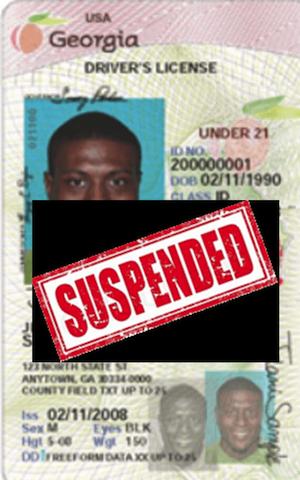
Teen drivers who violate Class D license restrictions face serious consequences. Georgia treats most traffic offenses as misdemeanors. A conviction on a teen's record can trigger license suspension well before points accumulate to the adult threshold.
Under the under-21 license suspension statute, any driver under 21 convicted of hit and run, racing, fleeing or attempting to elude an officer, reckless driving, DUI, or any offense carrying four or more points loses his or her license by operation of law. A plea of nolo contendere counts as a conviction for purposes of this statute. On a first suspension, the teen becomes eligible to apply for reinstatement after six months. A second or later suspension extends that waiting period to 12 months.
For drivers under 18, the threshold is even lower. Under the same statute, any teen under 18 who accumulates four or more violation points in any 12-month period will have his or her license suspended by the Georgia DDS. The department sends notice of suspension by certified mail.
Reinstatement requires paying the applicable fees and meeting any conditions set by the department. During the suspension period, the teen cannot legally drive. Parents should understand that even a single speeding ticket at a high enough speed could carry four points. This could trigger a suspension for a driver under 21.
These penalties make it critical for parents and teens to take any traffic citation seriously. An experienced traffic attorney may be able to help avoid a conviction. The attorney might reduce the charge to minimize the impact on a teen's driving record.
When a teen driver receives a traffic citation, parents are typically notified. Parents may need to appear in court alongside the minor. The court process varies by jurisdiction. Most Georgia courts require a parent or guardian to be present for any hearing involving a driver under 18.
A traffic attorney evaluates the facts of the stop and the citation. The attorney then recommends a path forward. Options may include fighting the ticket at trial, negotiating a reduction to a lesser offense, or entering a plea of nolo contendere. Georgia law allows each driver a once-in-a-lifetime nolo contendere plea. This prevents points from being assessed on a license. However, under Georgia law, a nolo plea still counts as a conviction for purposes of the under-21 suspension rules. This distinction matters greatly for teen drivers.
Preserving a teen's license often depends on acting quickly. Once a conviction is entered and reported to the DDS, the suspension process begins automatically. There is a limited window to challenge the citation or negotiate an alternative resolution. This must happen before the consequences take effect.
Every case is different. Outcomes depend on the specific facts, the jurisdiction, and the judge. If your teen driver is facing a traffic charge that could result in license suspension, consulting an attorney who handles Georgia traffic cases may help you understand your options.
If your teen is facing a traffic citation or license suspension under Georgia's Joshua's Law requirements, Kohn & Yager LLC offers free consultations to help you understand what is at stake. Our firm helps parents and teens navigate the license suspension rules that apply to drivers under 21 in Georgia.
Time matters in these cases. A suspension can take effect quickly once a conviction is reported to the Georgia DDS. Undoing a suspension is harder and more costly than preventing one. Depending on the circumstances of your case, we may be able to help pursue a resolution that protects your teen's ability to drive.
Call today to schedule a free consultation and discuss your teen's situation with a Georgia traffic defense lawyer.

Joshua's Law (Senate Bill 226) was passed by the Georgia legislature during the 2005 legislative session, and the requirements took effect on January 1, 2007. It was named after Joshua Brown, a Cartersville teen who died in a 2003 hydroplaning crash. The goal was to reduce teen driver fatalities. Before the law, Georgia had no mandatory driver education requirement for its youngest drivers, and Joshua's father, Alan Brown, led the effort to require formal training and supervised practice hours before teens could drive alone.
Yes. Georgia DDS now states that a 17-year-old applying for a Class D license must meet the same requirements as a 16-year-old. That means an approved driver education course, an alcohol and drug awareness course, 40 hours of supervised driving including 6 hours at night, and the DDS road skills test. A 17-year-old enlisted in the military may instead apply for a Class C license without the one-year permit period.
Penalties depend on the specific violation. Under Georgia law, any driver under 21 convicted of hit and run, racing, fleeing an officer, reckless driving, DUI, or an offense carrying four or more points has his or her license suspended by operation of law. After a first suspension, the teen may apply for reinstatement after six months. After a second or later suspension, that wait rises to 12 months.
The graduated licensing restrictions of Joshua's Law apply to Class D license holders, which covers drivers under 18. Once you turn 18, you apply for a standard Class C license. You must still pass the road skills test. The passenger limits and curfew rules no longer apply.